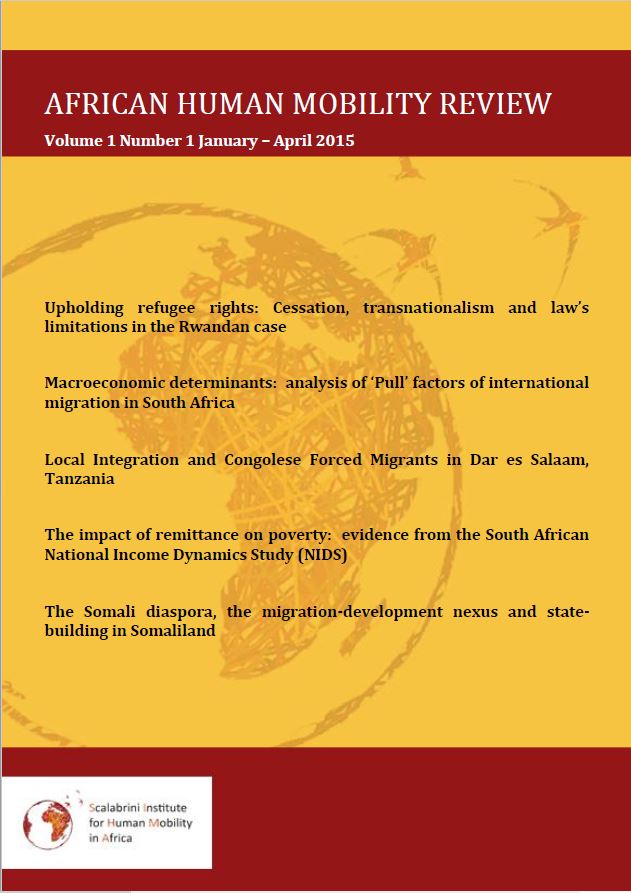
Upholding Refugee Rights: Cessation, Transnationalism and Law’s Limitations in the Rwandan Case
DOI:
https://doi.org/10.14426/ahmr.v1i1.729Keywords:
Cessation clause, Refugees, Repatriation, Human rights, Rwanda, UNHCRAbstract
The cessation clause epitomises the 1951 Refugee Convention’s internal barriers to the full achievement of refugees’ rights. By examining the controversial application of this provision in the case of Rwandan refugees, this paper demonstrates the resultant infringements on refugees’ human rights, and signals a key obstacle in understanding refugee experiences: institutional insistence on subjugating refugee perspectives and knowledge. This top-heavy ‘knowing what’s best’ for refugees must cede to alternative conceptualisations of refugee rights, especially in the well-worn durable solutions debate. A rights-based approach would see transnational mobility as a solution to challenges endured by camp-based refugees in particular. The Rwandan case study is grounded in theories of today’s membership-based nation-state paradigm, and questions whether re-inscribing refugees as primary agents of their own repatriation (with or without return) can bridge the divide inherent in the exclusionary citizenship-centric logic which ultimately structures the refugee rights system, and can adequately address problems rooted in complex identity politics.
Downloads
Issue
Section
License
Articles and reviews in AHMR reflect the opinions of the contributors. AHMR allows the author/s to retain full copyright in their articles. This is an open access journal which means that all content is freely available without charge to the user or his/her institution. Articles are made available under a Creative Commons license (CC-BY-4.0). Authors who have published under a CC BY 4.0 licence may share and distribute their article on commercial and non-commercial websites and repositories of their choice. Users are allowed to read, download, copy, distribute, print, search, or link to the full texts of the articles, or use them for any other lawful purpose, without asking prior permission from the publisher or the author/s provided the author/s is correctly attributed. This is in accordance with the BOAI definition of open access.