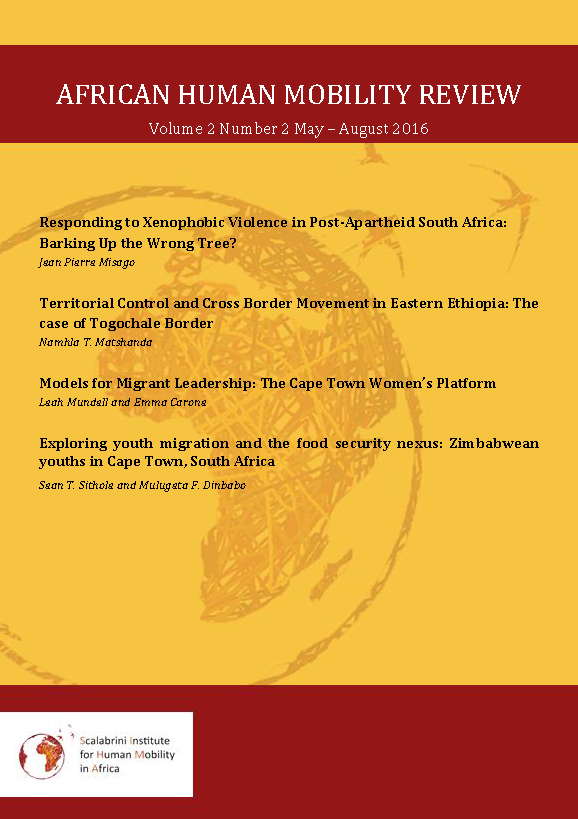
Exploring youth migration and the food security nexus: Zimbabwean youths in Cape Town, South Africa
DOI:
https://doi.org/10.14426/ahmr.v2i2.768Keywords:
Youth, Food security, Zimbabwe, South Africa, Cape Town, Migration, DevelopmentAbstract
In recent times, debates on the connection between migration and development surfaced as essential discourses in contemporary development issues. Consequently, this led to the birth of what is currently popularly coined as the migration-development nexus. In addition, there has been an evolution of the food security topic in various developmental discussions. Nevertheless, little attention has been given to the relationship between international migration and food security in the context of development in the global south. Moreover, missing in the literature is the conversation on migration and food security with particular attention to youths who constitute a vulnerable yet economically active group. Furthermore, there has been an ongoing engaging debate on the impact of remittances, whether remittances for household use are developmental in nature or not. This study, in contributing to the above debates, explores the link between youth migration and food security, and is based on a quantitative empirical study on Zimbabwean migrant youths in Cape Town, South Africa. The research presents comprehensive perspectives on the complexities linked to the reasons for youth migration in connection to food security, the importance of remittances on food security in the place of origin and levels of food insecurity in the place of destination. Results from this study can provide useful data for various stakeholders involved in both international migration and food security development agendas.
Downloads
Issue
Section
License
Articles and reviews in AHMR reflect the opinions of the contributors. AHMR allows the author/s to retain full copyright in their articles. This is an open access journal which means that all content is freely available without charge to the user or his/her institution. Articles are made available under a Creative Commons license (CC-BY-4.0). Authors who have published under a CC BY 4.0 licence may share and distribute their article on commercial and non-commercial websites and repositories of their choice. Users are allowed to read, download, copy, distribute, print, search, or link to the full texts of the articles, or use them for any other lawful purpose, without asking prior permission from the publisher or the author/s provided the author/s is correctly attributed. This is in accordance with the BOAI definition of open access.