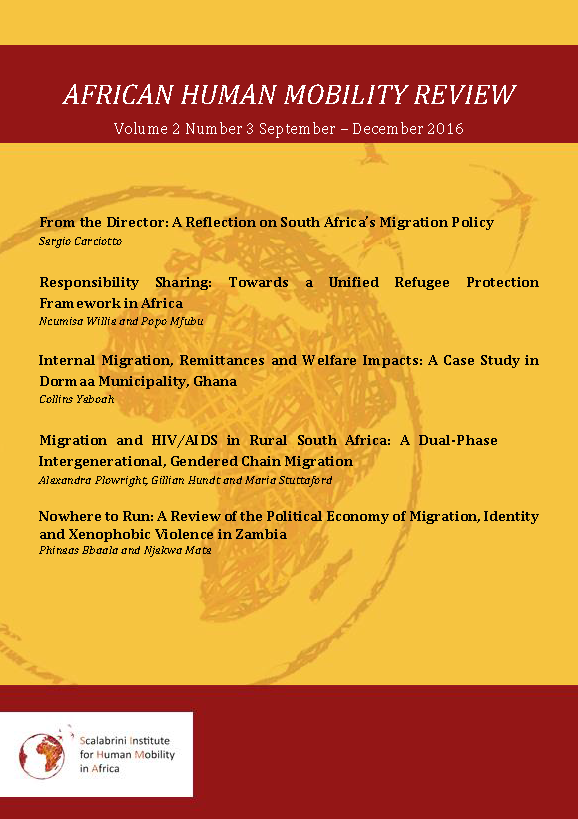
From the Director: A Reflection on South Africa’s Migration Policy
DOI:
https://doi.org/10.14426/ahmr.v2i3.771Abstract
Albeit geographically distant, Europe and South Africa have a great deal of similarities in their management of migratory flows. As many countries in Europe, South Africa is a migration hub attracting numerous migrants, including refugees, seasonal workers, students, cross-border traders and entrepreneurs from both the rest of Africa and Asia. South Africa is also considered, like European states, a country with a generous welfare system, where over 10 million people are living below the poverty threshold and are relying on social grants as a main source of income. Moreover, because of its strong social and economic contradictions, South Africa is not immune to divisive populist politics and xenophobic reactions. Although up to now no nationalist anti-immigration party has emerged in the political arena, immigrant workers (amakwerekwere1) are often accused of stealing jobs and being a burden on the country’s economy. On many occasions, the discontent of poor and disenfranchised black communities has raised tensions and led to violent clashes between locals and foreign nationals.
Downloads
Issue
Section
License
Articles and reviews in AHMR reflect the opinions of the contributors. AHMR allows the author/s to retain full copyright in their articles. This is an open access journal which means that all content is freely available without charge to the user or his/her institution. Articles are made available under a Creative Commons license (CC-BY-4.0). Authors who have published under a CC BY 4.0 licence may share and distribute their article on commercial and non-commercial websites and repositories of their choice. Users are allowed to read, download, copy, distribute, print, search, or link to the full texts of the articles, or use them for any other lawful purpose, without asking prior permission from the publisher or the author/s provided the author/s is correctly attributed. This is in accordance with the BOAI definition of open access.