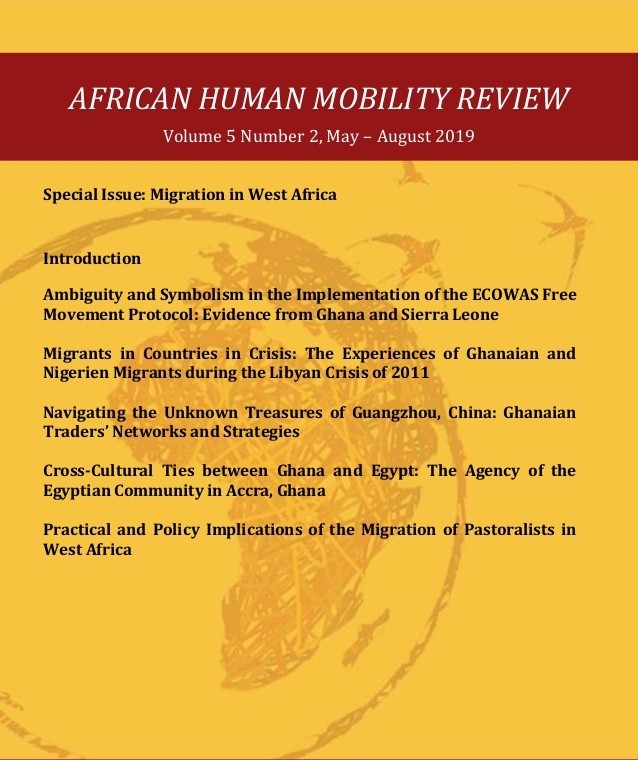
Ambiguity and Symbolism in the Implementation of the ECOWAS Free Movement Protocol: Evidence from Ghana and Sierra Leone
DOI:
https://doi.org/10.14426/ahmr.v5i2.881Keywords:
Free movement, Protocol, Ghana, Sierra Leone, ECOWASAbstract
This paper examines the challenges to the implementation of the Economic
Community of West African States (ECOWAS) Protocol on Free Movement, with
particular reference to Ghana and Sierra Leone. The paper is based on a desktop
review and in-depth interviews with selected ECOWAS migrants and officials of
institutions responsible for managing migration in Ghana and Sierra Leone. The
findings suggest that Ghana and Sierra Leone have made modest progress in the
implementation of the protocol. Apart from abolishing visa and entry
requirements for 90 days, both countries have adopted the standardized
ECOWAS Travel Certificate. Despite a few achievements, the following challenges
affect the implementation of the free movement protocol in both countries:
Policy ambiguities resulting from contradictions between national laws on
employment and the ECOWAS Free Movement Protocol; harassment of migrants;
migrants’ lack of travel documents; low level of knowledge about the ECOWAS
protocol; resource constraints; fears of competition with immigrants, especially
in Ghana; securitization of migration and migrants; weak labour market and
migration information systems, economic challenges and political instability.
This paper concludes that the future implementation outcomes of the ECOWAS
protocol largely depend on the commitment of the member states and financial
support that they receive from ECOWAS and its development partners.
Downloads
Issue
Section
License
Articles and reviews in AHMR reflect the opinions of the contributors. AHMR allows the author/s to retain full copyright in their articles. This is an open access journal which means that all content is freely available without charge to the user or his/her institution. Articles are made available under a Creative Commons license (CC-BY-4.0). Authors who have published under a CC BY 4.0 licence may share and distribute their article on commercial and non-commercial websites and repositories of their choice. Users are allowed to read, download, copy, distribute, print, search, or link to the full texts of the articles, or use them for any other lawful purpose, without asking prior permission from the publisher or the author/s provided the author/s is correctly attributed. This is in accordance with the BOAI definition of open access.