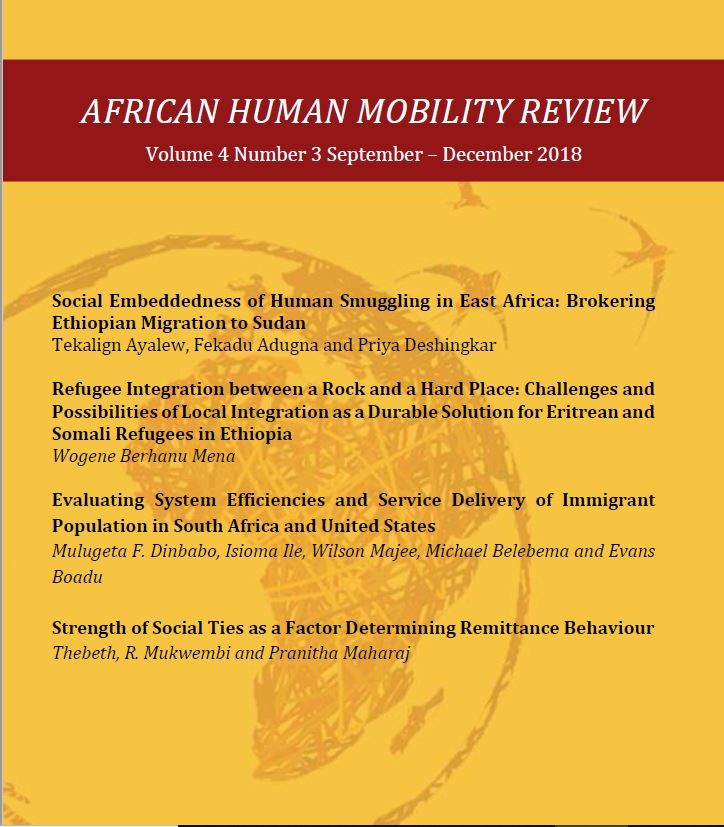
Social Embeddedness of Human Smuggling in East Africa: Brokering Ethiopian Migration to Sudan
DOI:
https://doi.org/10.14426/ahmr.v4i3.849Keywords:
Smuggling, Migration infrastructure, Borders, Knowledge, Migration controlAbstract
This article discusses the migration processes and brokering practices that link
Ethiopia and Sudan by taking into account the social, economic, political and
cultural underpinnings of human smuggling in the region. The analysis is based
on three months of fieldwork using a conventional qualitative research
methodology. Respondents were selected from actors such as smugglers,
migrants and government personnel involved in the migration process,
facilitation and control activities. Since the 1990s, significant irregular overland
labour migration has emerged from Ethiopian towns and villages to Khartoum,
Sudan via the border towns of Metema on the Ethiopian side and Galabat on the
Sudanese side. However, how various actors engage in shaping this migration
process and how human smuggling sustains despite increasing control efforts by
the state is less understood.
Downloads
Issue
Section
License
Articles and reviews in AHMR reflect the opinions of the contributors. AHMR allows the author/s to retain full copyright in their articles. This is an open access journal which means that all content is freely available without charge to the user or his/her institution. Articles are made available under a Creative Commons license (CC-BY-4.0). Authors who have published under a CC BY 4.0 licence may share and distribute their article on commercial and non-commercial websites and repositories of their choice. Users are allowed to read, download, copy, distribute, print, search, or link to the full texts of the articles, or use them for any other lawful purpose, without asking prior permission from the publisher or the author/s provided the author/s is correctly attributed. This is in accordance with the BOAI definition of open access.