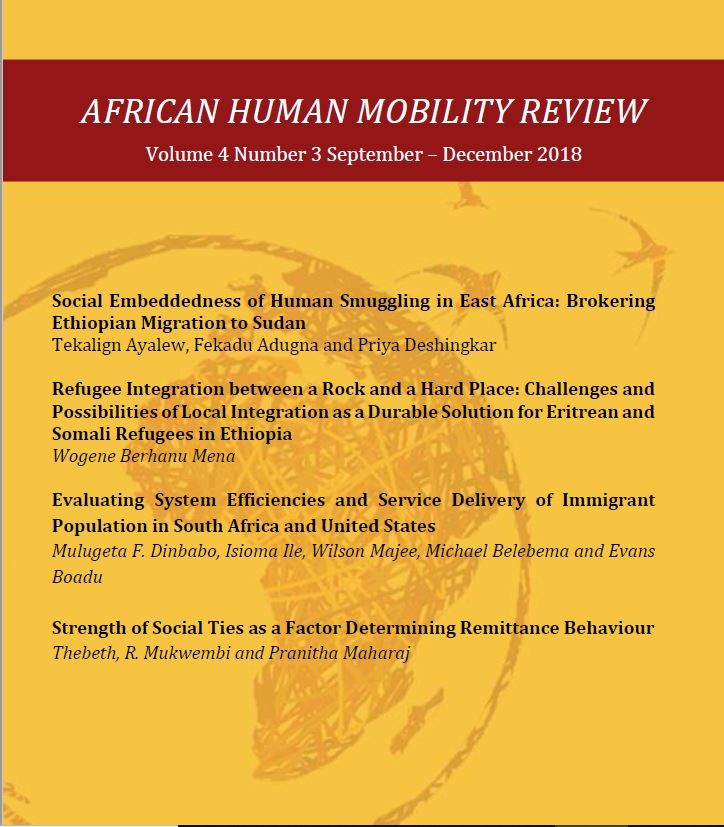
Refugee Integration between a Rock and a Hard Place: Challenges and Possibilities of Local Integration as a Durable Solution for Eritrean and Somali Refugees in Ethiopia
DOI:
https://doi.org/10.14426/ahmr.v4i3.850Keywords:
Refugees, Local integration, Securitisation, Politicisation, SomaliaAbstract
This study examines the challenges and possibilities of local integration for
urban refugees by comparing two refugee groups (Eritreans and Somalis) in
Addis Ababa. A qualitative research methodology was employed and semistructured interviews with refugees and host communities as well as key
informant interviews with the Administration of Refugees and Returnees Affairs
(ARRA) and local authorities were conducted. In addition, focus group
discussions (FGDs) with refugees and host communities of the study areas were
held. The respondents for both interviews and FGDs were purposively selected.
The historical and ongoing relations between Ethiopia and the refugee
producing countries, a structural factor, impacted not only the country’s policy
direction towards the refugees’ but also the refugees’ and hosts’ perceptions of
local integration. The study revealed that Somali refugees are more integrated
in the host communities than Eritrean refugees in the respective areas despite
the cultural compatibility of the latter because of the interplay of structural,
refugee and host community related factors.
Downloads
Issue
Section
License
Articles and reviews in AHMR reflect the opinions of the contributors. AHMR allows the author/s to retain full copyright in their articles. This is an open access journal which means that all content is freely available without charge to the user or his/her institution. Articles are made available under a Creative Commons license (CC-BY-4.0). Authors who have published under a CC BY 4.0 licence may share and distribute their article on commercial and non-commercial websites and repositories of their choice. Users are allowed to read, download, copy, distribute, print, search, or link to the full texts of the articles, or use them for any other lawful purpose, without asking prior permission from the publisher or the author/s provided the author/s is correctly attributed. This is in accordance with the BOAI definition of open access.