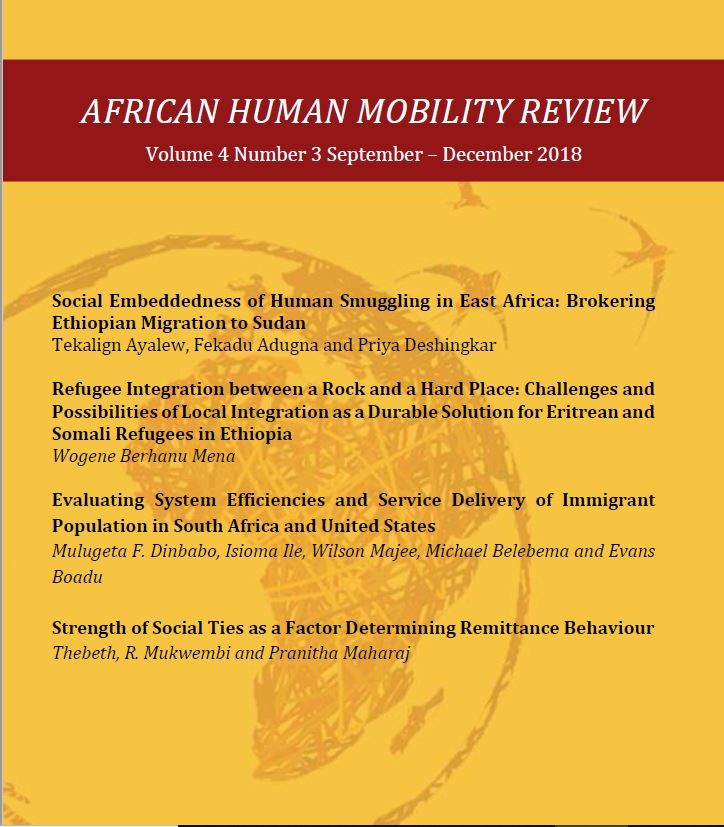
Understanding Relationships and Remittance Flow During the Migration Period: Strength of Social Ties as a Factor Determining Remittance Behaviour
DOI:
https://doi.org/10.14426/ahmr.v4i3.852Keywords:
Remittance flow, Migration, Relationships, Remittance recipients, TransnationalismAbstract
Remittances transferred between migrants and non-migrants play a major role
in alleviating poverty and improving social and economic well-being in many
developing countries. Although remittances are regarded as an outcome of
migration with far reaching effects as a livelihood strategy, not all non-migrants
with migrant family members are recipients of remittances. Remittances are not
transferred to all non-migrant family members in the country of origin. Migrants
identify particular individuals as recipients of remittances, which they send to
their home countries during the migration period. Therefore, it is important to
understand the determinants of remittance flow and remittance behaviour
during the migration period. This study explores relationships between migrants
and non-migrants and how such relations influence the flow of remittances
during the migration period. A qualitative approach was employed in which 60
interviews were conducted (30 with Zimbabwean migrants in Durban and 30
with their respective family members in Zimbabwe). The study found that the
strength of social ties between migrants and non-migrants plays a major role in
determining remittance flows.
Downloads
Issue
Section
License
Articles and reviews in AHMR reflect the opinions of the contributors. AHMR allows the author/s to retain full copyright in their articles. This is an open access journal which means that all content is freely available without charge to the user or his/her institution. Articles are made available under a Creative Commons license (CC-BY-4.0). Authors who have published under a CC BY 4.0 licence may share and distribute their article on commercial and non-commercial websites and repositories of their choice. Users are allowed to read, download, copy, distribute, print, search, or link to the full texts of the articles, or use them for any other lawful purpose, without asking prior permission from the publisher or the author/s provided the author/s is correctly attributed. This is in accordance with the BOAI definition of open access.