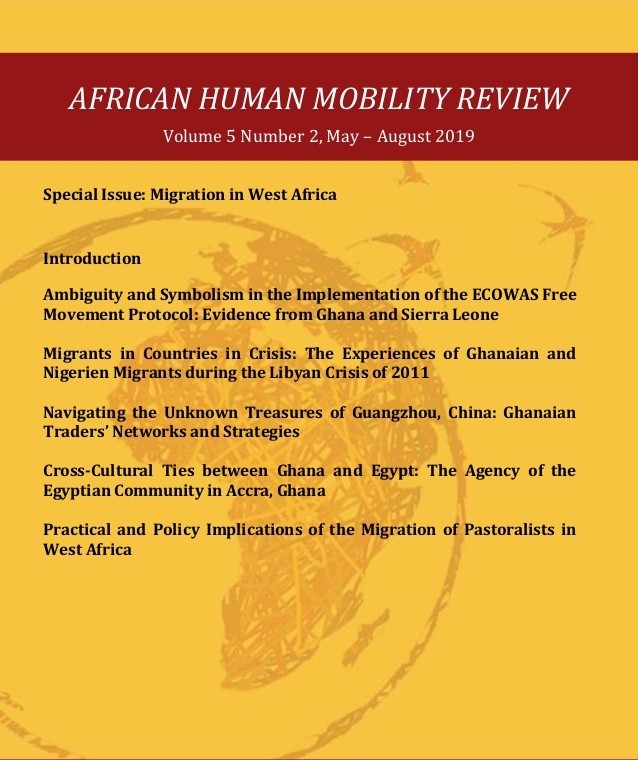
Migrants in Countries in Crisis: The Experiences of Ghanaian and Nigerien Migrants during the Libyan Crisis of 2011
DOI:
https://doi.org/10.14426/ahmr.v5i2.882Keywords:
Libya, Ghanaian migrants, Nigerian migrants, Crisis situation, Motivations for migrationAbstract
Using the experiences of Ghanaian and Nigerian migrants who were implicated
in the 2011 Libyan crisis as a case study, this paper highlights the importance of
examining micro-level factors in explaining migration decision-making
processes. It therefore challenges the uncritical use of macro-level factors as
exogenous ‘root causes’ of migration especially in developing country contexts.
Adopting mainly qualitative approaches among seventy-five key informants
from six distinct categories, the study finds that migration culture, household
livelihood aspirations, geographical propinquity, the existence of social networks
and migrant smuggling rings motivate migrations to Libya. The paper also
challenges scholarship on the 2011 Libyan crisis that treats the experiences of
sub-Saharan African (SSA) migrants in the country as an undifferentiated group.
The paper concludes that within a developing country context, the political
economy of the origin country contributes to the establishment, over time, of a
migration culture especially among youth who feel trapped in ‘waithood’ and are
unable to realize basic socio-cultural and economic markers in life. The paper
recommends the regionalization of evacuation and repatriation programmes to
facilitate the timely extraction of trapped migrants from countries in crisis.
Downloads
Issue
Section
License
Articles and reviews in AHMR reflect the opinions of the contributors. AHMR allows the author/s to retain full copyright in their articles. This is an open access journal which means that all content is freely available without charge to the user or his/her institution. Articles are made available under a Creative Commons license (CC-BY-4.0). Authors who have published under a CC BY 4.0 licence may share and distribute their article on commercial and non-commercial websites and repositories of their choice. Users are allowed to read, download, copy, distribute, print, search, or link to the full texts of the articles, or use them for any other lawful purpose, without asking prior permission from the publisher or the author/s provided the author/s is correctly attributed. This is in accordance with the BOAI definition of open access.