From bloom to bust
Understanding Namaqualand as a potential green sacrifice zone
DOI:
https://doi.org/10.14426/na.v99i1.3198Keywords:
South Africa, Karoo, Namaqualand, Moning, Environment, Concordia, Extractivism, Socio-ecological dispossessionAbstract
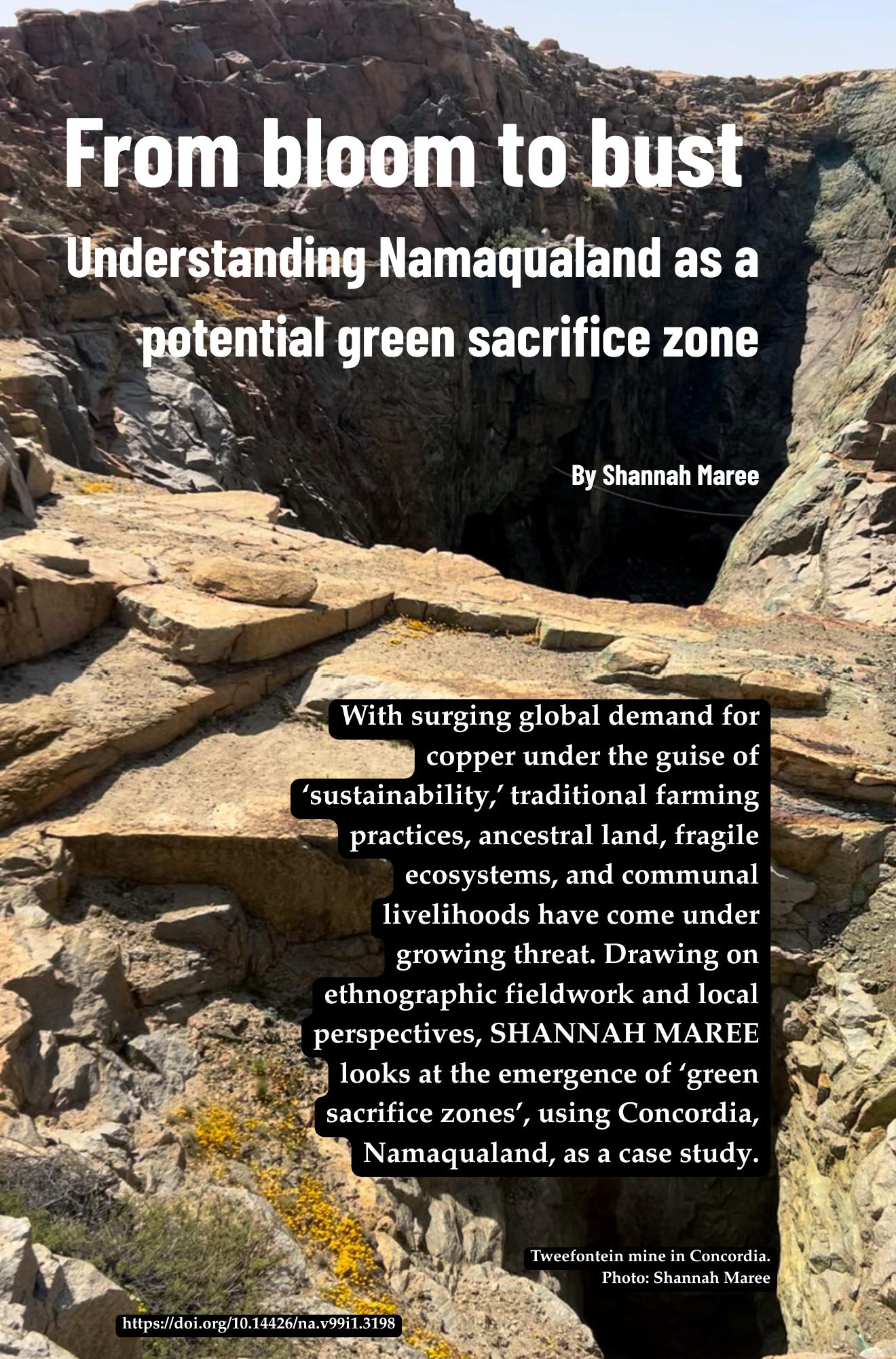
As global demand for copper intensifies − driven by its essential role in renewable energy systems and technological advancement − previouslydormant mining regions such as Namaqualand in South Africa’s Northern Cape are being reimagined as new extractive frontiers. This article examines Concordia, a quaint town in Namaqualand, as a case study to interrogate the socio-ecological implications of renewed copper extraction under the guise of the green transition. While framed as ushering in development, these renewed mining ventures risk reproducing historical patterns of capitalist extractivism, now reframed as ‘green’ or sustainable.
Drawing on fieldwork, interviews, and historical context, this article employs the concept of ‘green sacrifice zones’ to analyse how residents and subsistence farmers in Concordia confront threats to land access, cultural heritage, water resources, and livelihoods. It argues that unless inclusive, participatory, and historically informed approaches are adopted, the green energy transition may deepen existing inequalities and lead to reimagined forms of socio-ecological dispossession.
Downloads
Downloads
Published
Issue
Section
License

This work is licensed under a Creative Commons Attribution-NoDerivatives 4.0 International License.